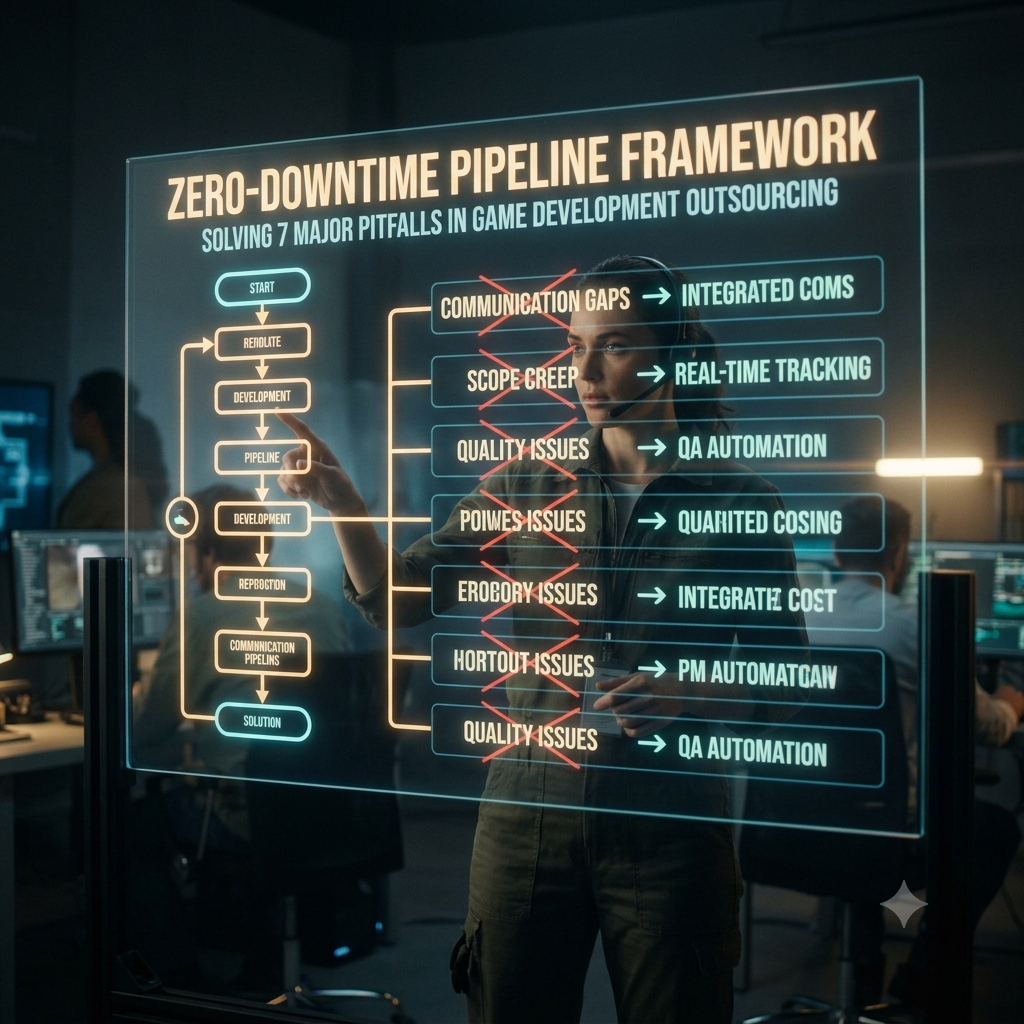
Game development outsourcing gets a new standard: Kevuru Games’ Zero-Downtime Pipeline fixes 7 common pitfalls. See the framework and get a quote.
WASHINGTON D.C., DC, UNITED STATES, July 22, 2026 /EINPresswire.com/ — Kevuru Games has formalized a new production framework for outsourced teams. The Zero-Downtime Pipeline packages years of contract experience into a repeatable process, closing seven gaps that typically stall client projects in the first weeks of a partnership.
As a video game development studio working across art, code, and full production support for studios and publishers, Kevuru built the framework from patterns observed across hundreds of shipped titles. For any team evaluating game development outsourcing, it offers a concrete checklist of what a disciplined partner setup should include before a single asset or build changes hands.
Key Takeaways
– The Zero-Downtime Pipeline addresses seven recurring outsourcing failure points, from security to team retention.
– It standardizes onboarding so external teams integrate into a client’s build pipeline from day one.
– The framework is built on Kevuru’s ongoing video game development work with EA, Epic Games, and Lucasfilm.
1. What Does an IP & Security Protocol Standard Look Like?
A standardized IP and security protocol means every engagement opens with the same non-disclosure agreement structure, data-handling terms, and asset-ownership language, reviewed before any files transfer. Kevuru applies this baseline regardless of project size, so client studios do not need to draft custom protections for a single contract. Portfolio use, storage, and access are defined up front, closing the ambiguity that often delays kickoff by weeks.
2. CI/CD Integration From Day One
Many outsourcing relationships lose the first sprint to environment setup. The Zero-Downtime Pipeline requires direct integration into the client’s existing build pipeline before production work begins, not after. Kevuru’s technical leads map repository access, branch permissions, and automated build checks during onboarding, so assets and code land in the client’s continuous integration and delivery system on schedule rather than arriving as disconnected file drops that someone has to reconcile later.
3. Eliminating Communication Latency
Time-zone mismatch is a quiet productivity drain in distributed production. The framework sets synchronized core hours between the outsourced team and the client’s internal staff, plus a shared workspace on Slack or Discord from the first day of the contract. Questions get answered within the same working window instead of overnight, which keeps blockers from compounding across a sprint.
4. Fixing Quality Benchmark Misalignment
Vague creative direction is a common source of rework. Kevuru now locks visual and technical targets during pre-production: reference sheets, polycount and FPS ceilings, and style guides are agreed upon and signed off before full production starts. This single step, establishing clear benchmarks early, has proven to cut revision cycles significantly on art-heavy engagements, since both sides are grading against the same standard from the start.
5. Scope Creep Management
Unchecked scope changes are one of the most cited reasons outsourced projects run over budget. The Zero-Downtime Pipeline replaces open-ended task lists with milestone-based agile sprint planning, where new requests are logged, scoped, and scheduled into a future sprint rather than absorbed mid-cycle. Clients retain flexibility to adjust priorities, but every change is visible and estimated instead of silently expanding the original brief.
6 Asset Optimization Checks
Assets that pass creative review can still fail technical requirements once they reach engine. Kevuru now runs strict technical quality assurance, checking topology, texture budgets, naming conventions, and engine compatibility, before any pull request goes out. Catching these issues internally means client engineers spend their time integrating finished assets, not sending them back for cleanup.
7. Retention Stability
Losing a team member mid-project is costly in any outsourcing arrangement, since replacements need time to absorb undocumented context. The framework assigns a dedicated, named team to each client for the full length of the engagement, rather than pulling from a rotating pool. That continuity protects institutional knowledge about a project’s specific pipeline, style decisions, and technical constraints, and it gives client leads a consistent point of contact throughout production.
A Standard for the Full Engagement
Taken together, these seven fixes describe what Kevuru Games considers a baseline for reliable outsourced production, not a premium add-on. The Zero-Downtime Pipeline formalizes practices the studio has refined across years of art and development contracts for game studios, publishers, and independent teams, spanning mobile, console, PC, and VR titles.
Each protocol maps to a specific point where outsourced projects commonly stall: security ambiguity at kickoff, pipeline disconnects in week one, time-zone gaps mid-sprint, mismatched creative direction, uncontrolled scope, technical debt hiding in assets, and staff turnover eroding project memory. Removing any single point of friction helps; removing all seven together is what the framework is built to guarantee.
Studios weighing an outsourcing partner can use the seven points above as a due-diligence checklist for any vendor conversation, whether or not that vendor is Kevuru. Teams ready to see the framework applied to a specific production can reach out to Kevuru Games directly to scope a project against it.
FAQs
What is the Zero-Downtime Pipeline?
It is Kevuru Games’ internal framework for onboarding and running outsourced game production, covering security protocol, build-pipeline integration, communication structure, quality benchmarks, scope management, asset QA, and team retention.
Which studios does Kevuru Games work with?
Kevuru has provided art and development services to teams including EA, Epic Games, and Lucasfilm, alongside independent and mid-size studios across mobile, console, and PC projects.
Does the framework apply to short-term contracts as well as long-term partnerships?
Yes. The seven protocols are designed as a baseline for any engagement length, though the retention and CI/CD integration steps deliver the most value on multi-month or ongoing production work.
How does a studio start an engagement under the Zero-Downtime Pipeline?
A project typically opens with an NDA and scope call, followed by pipeline and build-access mapping before any production tasks are assigned, so the security and integration steps are already in place once work begins.
Oleg Goncharenko
Alltegrio
+1 424-413-5692
email us here
Legal Disclaimer:
EIN Presswire provides this news content “as is” without warranty of any kind. We do not accept any responsibility or liability
for the accuracy, content, images, videos, licenses, completeness, legality, or reliability of the information contained in this
article. If you have any complaints or copyright issues related to this article, kindly contact the author above.

Media gallery